Commercial Solar & EV Infrastructure: Engineering Long-Term Energy Savings for Washington Properties
A Technical Guide to Utility-Interactive Systems and Future-Ready Electrification
Table of Contents
1. What Makes Commercial Solar Different from Residential Systems
2. How Commercial Solar Reduces Operating Expenses
3. Understanding Utility-Interactive Commercial Systems
4. Commercial Solar Financial Performance: Real Numbers
5. 2025 Federal Tax Credit Changes: What Businesses Need to Know
6. EV Charging Infrastructure: Why Planning Matters Now
7. Washington's Electrification Requirements for Commercial Properties
8. The Sun's Eye Solar Commercial Process
9. Common Questions Commercial Property Owners Ask
10. Next Steps: Schedule a Commercial Energy Assessment
What Makes Commercial Solar Different from Residential Systems
Commercial solar installations operate under different technical, regulatory, and economic frameworks than residential rooftop arrays. Understanding these distinctions is essential for property owners evaluating solar as a capital improvement.
System Scale and Design Complexity
Residential solar systems typically range from 4–10 kW. Commercial installations scale from 25 kW for small retail buildings to 500+ kW for industrial warehouses, distribution centers, or multi-tenant office complexes.
Larger systems require:
- Three-phase electrical service integration — Most commercial buildings use three-phase power, requiring inverter configurations and utility interconnection agreements that differ substantially from residential single-phase systems
- Structural engineering analysis — Rooftop loading calculations must account for ballasted racking systems (on flat roofs), wind uplift forces, and snow loads specific to Washington climate zones
- Advanced monitoring and control systems — Commercial-grade monitoring tracks production at the inverter level, integrates with building management systems (BMS), and provides real-time performance data for facilities managers
These technical differences aren't obstacles; they're design considerations we handle during the engineering phase to ensure the system performs reliably over its 25–30 year operational life.
Regulatory and Permitting Requirements
Commercial projects follow the Washington State Energy Code for Commercial Buildings (WSEC-C), not the residential code. Key distinctions include:
- Authority Having Jurisdiction (AHJ) coordination — Larger installations require plan review by county or city commercial building departments, fire marshals (for rooftop access pathways and setbacks), and utility engineering departments for interconnection approval
- Prevailing wage requirements — Some jurisdictions and incentive programs require Davis-Bacon or local prevailing wage compliance for installations over specific kilowatt thresholds
- Performance bonds and insurance — Commercial contractors carry higher liability coverage and may be required to post performance bonds on municipal or developer-funded projects
Sun's Eye Solar navigates these requirements as standard operating procedure. Our design documentation is prepared to meet commercial code standards from the outset, minimizing back-and-forth with permit offices and preventing construction delays.
Different Financial Incentive Structures
While residential solar benefits from the federal Residential Clean Energy Credit (30% tax credit), commercial properties access different—and recently updated—incentive mechanisms:
- Investment Tax Credit (ITC) — Commercial solar qualifies for the federal ITC, currently 30% of total project costs through specific deadlines (see Section 5 for critical 2025 changes), with bonus credits available for domestic content and energy community siting
- 100% Bonus Depreciation — Allows commercial property owners to fully expense solar assets in the first year. Note: The previous 5-year MACRS schedule has been eliminated for new projects under 2025 tax law changes
- State and utility incentives — Washington utilities (Puget Sound Energy, Tacoma Power, Seattle City Light) offer commercial solar production incentives and net metering programs with commercial rate structures that differ from residential tariffs
The combination of ITC and 100% bonus depreciation creates substantial tax benefits for profitable businesses. However, new eligibility restrictions enacted in 2025 make timing critical for project developers—details covered in Section 5.
Commercial Solar Financial Performance: Real Numbers
Financial analysis drives commercial solar decisions. Property owners evaluate projects based on return on investment (ROI), payback periods, net present value (NPV), and internal rate of return (IRR)—not abstract environmental benefits.
Typical Commercial Solar Economics in Washington
Project Parameters:
- System size: 50 kW rooftop array
- Total installed cost: $125,000 ($2.50 per watt)
- Annual production: 55,000 kWh (based on Tacoma solar irradiance)
- Current utility rate: $0.12 per kWh (blended commercial rate)
- Annual utility escalation: 3.5%
Incentive Stack:
- Federal ITC (30%): $37,500 (subject to new eligibility requirements—see Section 5)
- 100% Bonus Depreciation: Full expensing in Year 1 (actual tax benefit depends on property owner's tax bracket)
Net Investment: $87,500 (after ITC; depreciation value phases in based on taxable income)
Annual Savings: $6,600 (Year 1)
Financial Metrics:
- Simple payback: 13.3 years
- 25-year NPV (5% discount rate): $87,000
- IRR: 8.2%
These returns improve substantially for properties with higher electricity rates, demand charge structures, or ability to fully utilize depreciation benefits. However, projects that miss new ITC deadlines will see dramatically different economics—discussed in detail in Section 5.
2025 Federal Tax Credit Changes: What Businesses Need to Know
On July 4, 2025, the newly enacted One Big Beautiful Bill (OBBB) fundamentally changed the timeline and eligibility requirements for the federal Investment Tax Credit (ITC). While the 30% credit remains available, access to it is now governed by strict construction deadlines and compliance conditions that directly affect project planning for 2026 and beyond.
Critical Deadline: July 4, 2026
Commercial solar projects must now qualify under one of two pathways to secure the 30% ITC (according to updated IRS guidance):
| Qualification Method | Project Started | Completion Deadline | Result |
|---|---|---|---|
| Start Construction/Safe Harbor | Before July 4, 2026 | Within 4 years (2029-2030) | ✅ Eligible for 30% ITC |
| Place in Service | After July 4, 2026 | By December 31, 2027 | ✅ Eligible for 30% ITC |
| Neither Met | After July 4, 2026 | After Dec 31, 2027 | ❌ No ITC |
Source: IRS safe harbor guidance, August 2025
What 'Beginning Construction' Actually Means
Treasury's August 2025 guidance significantly tightened the definition of 'construction commenced' for ITC purposes:
- Projects larger than 1.5 MW must satisfy the Physical Work of a Significant Nature Test. Simply spending 5% of project costs is no longer sufficient. Qualifying work includes off-site manufacturing under binding contracts (transformers, inverters) or on-site activity such as grading, foundations, or racking installation.
- Smaller projects (≤1.5 MW) may still use the 5% cost-incurred rule. However, systems owned by the same taxpayer sharing interconnection and placed in service in the same year must aggregate output to stay under the 1.5 MW threshold.
- Continuity Requirement: Once construction starts, developers must either place the project in service within four years of the year construction began (e.g., 2025 projects must finish by 2029), or maintain continuous physical work of a significant nature throughout development.
Failure to meet either standard risks complete disqualification from the 30% ITC—not a reduced credit, but zero federal tax benefit.
Foreign Entity of Concern (FEOC) Sourcing Requirements
The OBBB introduces new restrictions on equipment sourcing. Projects using components manufactured by Foreign Entities of Concern (primarily Chinese-owned manufacturers) face graduated disqualification thresholds:
- 2026 projects: Maximum 60% of component costs from FEOC sources
- 2030 and beyond: Maximum 40% from FEOC sources
- Projects exceeding these thresholds are ineligible for the ITC entirely
This requirement applies to solar modules, inverters, battery storage components, and structural racking. Property owners must coordinate with installers to verify supply chain sourcing and maintain documentation proving compliance. Sun's Eye Solar works exclusively with ITC-compliant equipment suppliers and provides full sourcing documentation as part of our standard project delivery.
Battery Storage Systems: Same Rules Apply
Standalone battery energy storage systems (Section 48E) are subject to identical deadlines and FEOC sourcing rules. Storage-only or hybrid solar + storage systems must either begin construction by July 4, 2026 or be in service by December 31, 2027 to qualify for the 30% credit.
100% Bonus Depreciation Still Available—But MACRS Eliminated
The 100% bonus depreciation remains intact, allowing businesses to fully expense qualifying solar and storage assets in the first year. However, the previous 5-year MACRS (Modified Accelerated Cost Recovery System) schedule has been eliminated for new projects.
This change impacts how solar investments appear on balance sheets and integrate into multi-year tax planning. Full-expensing delivers powerful short-term savings but compresses the benefit into a single tax year. Property owners should consult CPAs to model depreciation strategies based on projected taxable income across the project timeline.
What This Means for Washington Commercial Projects
For property owners planning commercial solar installations in 2026 or later, the July 4, 2026 deadline creates an immediate decision point:
- Projects currently in design: Accelerate procurement and construction timelines to begin physical work before the deadline
- Projects planned for 2027-2028: Either fast-track to meet safe harbor requirements or accept that the project must be fully operational by December 31, 2027
- Multi-phase developments: Structure phases to qualify independently, ensuring each phase meets construction or service deadlines
Sun's Eye Solar tracks these requirements for all commercial clients and structures project schedules to maximize ITC eligibility while maintaining construction quality and permit compliance. We recommend scheduling initial consultations no later than Q1 2026 for any project planned before the December 31, 2027 service deadline.
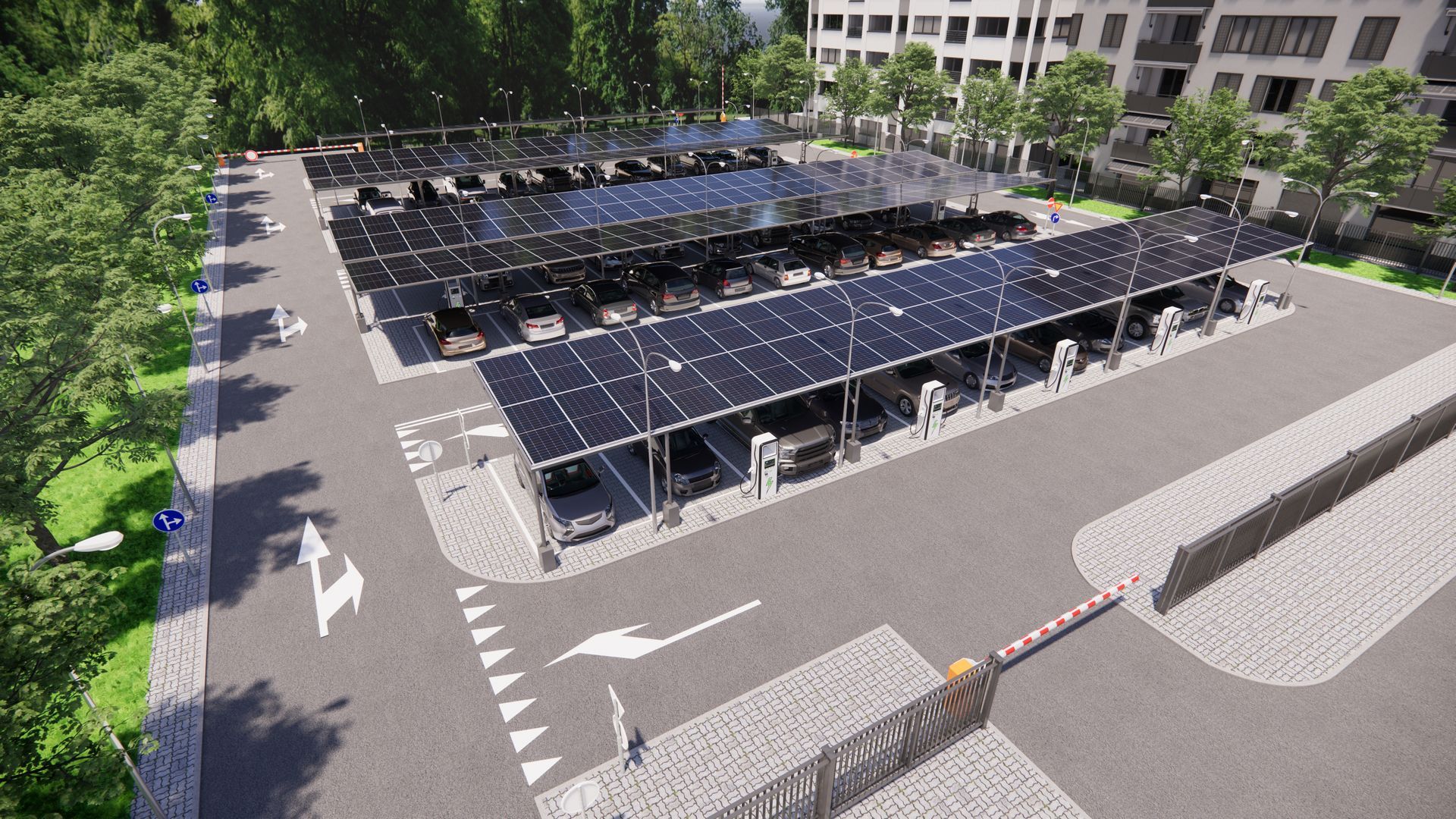
EV Charging Infrastructure: Why Planning Matters Now
Washington State legislation is accelerating commercial building electrification requirements. Planning EV charging infrastructure before it becomes mandatory avoids costly retrofits, positions properties competitively for tenants and customers, and aligns with utility programs offering installation incentives.
Washington's EV Infrastructure Trajectory
Current and upcoming legislative drivers include:
House Bill 1287 (Effective 2024)
House Bill 1287 requires new commercial buildings and substantial renovations to include EV charging infrastructure:
- New multifamily buildings (3+ units): 10% of parking spaces must include EV-ready electrical infrastructure; 1 additional space must have an operational Level 2 charger for every 25 spaces
- New commercial buildings: 10% of parking spaces must include EV-ready infrastructure
- Substantial renovations: Projects altering 50%+ of a building's structure trigger compliance
Frequently Asked Questions
Q: What's the typical payback period for commercial solar in Washington?
A: 8–14 years depending on system size, electricity rates, and incentive utilization. Properties with demand charges, high utility rates (Seattle City Light commercial accounts), or ability to maximize depreciation see faster paybacks (6–9 years). However, projects that miss new ITC deadlines will see significantly longer payback periods due to loss of the 30% federal credit.
Q: Do the new ITC changes affect projects already under contract?
A: Projects that began construction before July 4, 2026 under IRS safe harbor rules are protected under the original ITC timeline. However, they must still complete within four years of the year construction began. Projects with signed contracts but no physical work started must meet the new requirements.
Q: Can solar systems operate during power outages?
A: Standard grid-tied systems shut down during outages for utility worker safety (required by IEEE 1547 interconnection standards). Battery storage systems with islanding controls can provide backup power to critical loads during outages while solar continues charging batteries during daylight hours.
Q: How do I ensure my project meets FEOC sourcing requirements?
A: Work with a qualified solar installer who maintains relationships with ITC-compliant equipment manufacturers. Sun's Eye Solar provides full supply chain documentation showing country of origin for all major components (modules, inverters, racking, battery systems) and ensures projects meet the applicable FEOC thresholds for the installation year.
External Citations and Resources
This article references the following authoritative sources:
• Washington State Building Code Council — Commercial Energy Code
• Federal Investment Tax Credit — IRS
• 2025 Commercial Solar Tax Credit Changes — PPM Solar Industry Analysis
• House Bill 1287 — EV Infrastructure Requirements
• Washington Clean Energy Transformation Act (CETA)
• Washington Building Performance Standards
Next Steps: Schedule a Commercial Energy Assessment
If you're managing a commercial property, HOA, warehouse, retail facility, or municipal building in Western Washington and want to understand whether solar and EV infrastructure make financial sense for your specific situation, Sun's Eye Solar offers comprehensive commercial energy assessments.
Given the new July 4, 2026 ITC deadline, we strongly recommend scheduling consultations in Q1 2026 for any project planned before December 31, 2027.
Our assessment process includes:
• Site visit and electrical service evaluation
• Utility bill analysis and load profiling
• ITC qualification analysis and safe harbor strategy
• FEOC-compliant equipment sourcing verification
• Detailed financial projections with updated tax incentive modeling
• EV infrastructure integration planning
• Regulatory compliance review (CETA, Building Performance Standards, local requirements)
Contact Sun's Eye Solar to discuss your property's energy profile, electrification goals, and timeline. We'll provide straightforward analysis showing whether solar makes sense for your situation and what the actual numbers look like under the new ITC rules.